 Carlos D. Prado S.
PhD research · Neuromorphic hardware
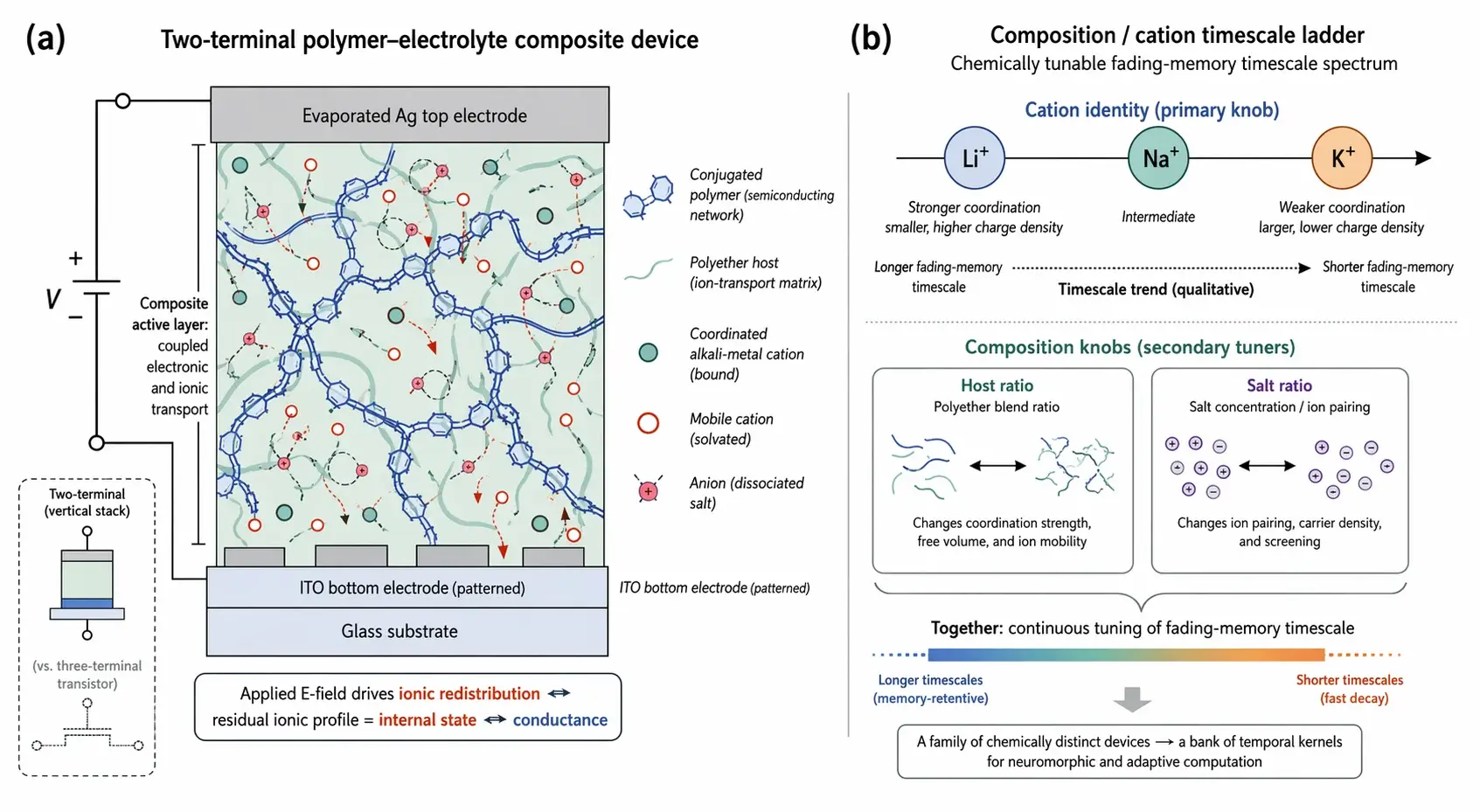
Polymer memristors for temporal computing
Experimental devices with chemically tunable fading memory, connected to reservoir-computing simulations and physiological signal benchmarks.
- Role
- Experimental research, data pipeline design, modelling, analysis, and scientific illustration
- Period
- 2022–2026
- Status
- Thesis in progress
Challenge
What the work needed to resolve.
Determine which device variables reproducibly tune volatile memory, then test whether those dynamics provide measurable value on temporal-computing tasks.
Approach
A system designed for scrutiny.
- 01
Rebuilt the experimental archive around specimen-level provenance and automated feature extraction.
- 02
Scoped the strongest quantitative claim to a replicated PEO/lithium-triflate composition series.
- 03
Fitted compact device models and evaluated heterogeneous banks on memory, WESAD, and CASE benchmarks.
Inside
What the system actually produces.
The figures below are rebuilt in the portfolio from synthetic series, so they show the shape of each output without carrying any real data out of the project.
Relaxation after a write pulse. Composition moves the time constant across roughly an order of magnitude, which is what makes the device useful as a temporal filter.
A bank of devices with different timescales spans more of the memory curve than any single composition — the reason heterogeneity is worth the fabrication cost.
Outcome